
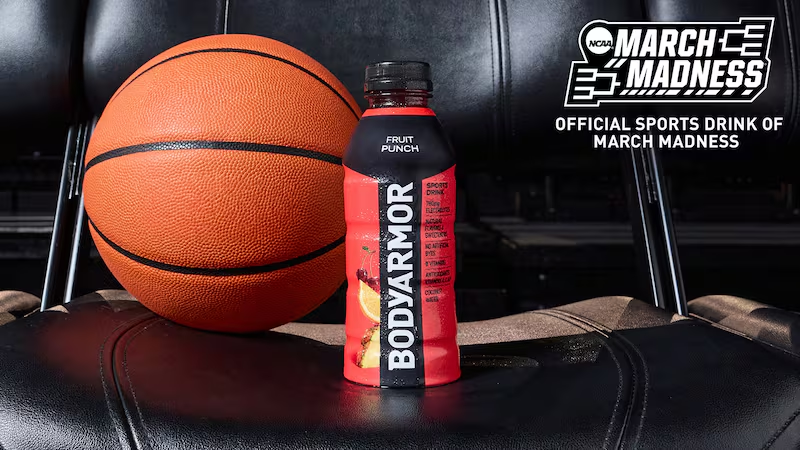
Coca-Cola is making a strategic shift in college sports: BodyArmor will replace Powerade on the sidelines of March Madness this year as the beverage giant attempts to salvage a struggling sports drink division.
The move reflects Coca-Cola’s ongoing challenge in competing against Gatorade, which controls more than 60% of the sports drink market while BodyArmor and Powerade each hold only mid-teen market share percentages.
The $960 Million Problem
Coca-Cola acquired BodyArmor in 2021 for $8 billion, expecting to challenge Gatorade’s dominance within five years.
Instead, the company has taken $960 million in write-downs on the BodyArmor brand in the past two years—a clear signal that the acquisition hasn’t delivered expected returns.
BodyArmor, despite being a $1.5 billion brand by revenue, still struggles with awareness and market penetration. The March Madness sponsorship represents an attempt to change that equation through high-visibility college basketball placements.
The Strategy Behind the Shuffle
Coca-Cola’s approach is becoming clearer:
BodyArmor = Focus on North American, younger-skewing audiences through college sports and athlete endorsements
Powerade = International expansion and established partnerships like U.S. Soccer and MLS
The company promoted Powerade ahead of this summer’s World Cup to solidify its position in soccer while targeting younger U.S. consumers. Now BodyArmor gets the college basketball spotlight.
According to BodyArmor CMO Tom Gargiulo: “It just made sense to align all of our North American assets with BodyArmor, and all of our broader, more international assets with the Powerade brand.”
The New BodyArmor Campaign
BodyArmor is backing its March Madness presence with significant investment:
✓ Features NBA player Jalen Brunson and LSU athlete Flau’jae Johnson
✓ Runs during men’s and women’s NCAA tournaments
✓ Includes NIL partnerships with 20-40 athletes
✓ Part of a major brand refresh featuring athletes like Joe Burrow, Sabrina Ionescu, and Connor McDavid
The NIL strategy is particularly notable—college sports are now expected to include athlete endorsement deals as part of sponsorship activation.
The Category Problem
Coca-Cola isn’t just competing with Gatorade anymore. The sports drink category has fractured with celebrity-backed brands:
- Prime (Jake Paul backing)
- Mas+ (Lionel Messi involvement)
- Plezi (Steph Curry)
- Other emerging brands
These celebrity-driven competitors are reshaping consumer expectations around sports drink marketing.
Electrolit, backed by Keurig Dr Pepper, has been one of the fastest-growing brands in the category, suggesting that the traditional Gatorade-dominated market is opening up.
Why March Madness Matters
College basketball reaches younger consumers who haven’t yet formed brand loyalty around sports drinks. March Madness specifically offers:
✓ National broadcast visibility
✓ Emotional fan engagement
✓ Demographic alignment with BodyArmor’s target audience
✓ Platform for athlete association and NIL deals
For a brand struggling with awareness despite significant revenue, the exposure opportunity justifies the sponsorship investment.
The Bigger Picture
Coca-Cola’s strategy reveals the challenges facing legacy sports drink brands. Gatorade’s market dominance is being challenged not just by BodyArmor and Powerade, but by entirely new competitors with celebrity endorsements and different positioning.
The company is essentially betting that BodyArmor, with fresh endorsers and increased visibility through college sports, can eventually compete more effectively in a category that’s becoming more fragmented and celebrity-driven.