
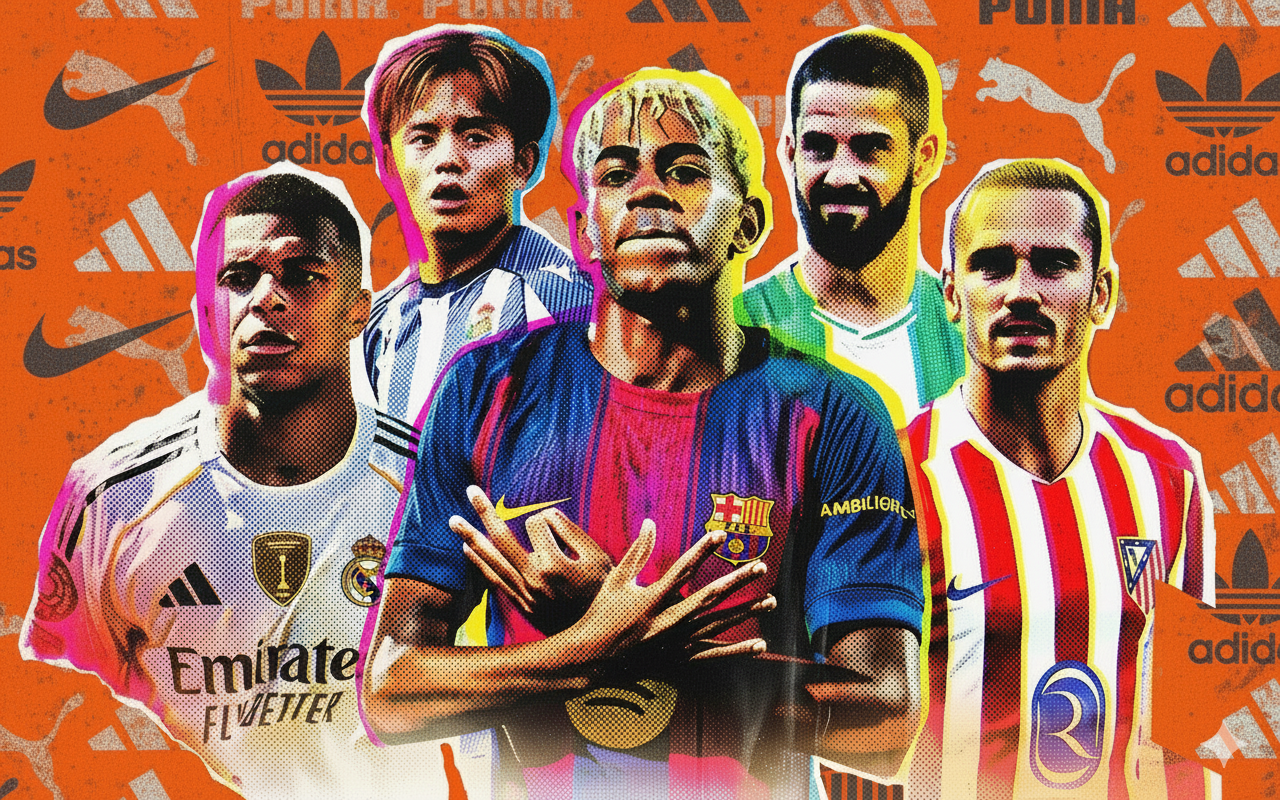
The data from the last seven seasons reveals a fascinating power struggle in Spanish football’s most prestigious league. Global sportswear giants have executed strategic maneuvers that have shifted the balance of kit supplier dominance in La Liga multiple times, creating a competitive landscape that extends far beyond the pitch.
Nike’s “Steady Hegemon” Position
Across all seven seasons examined, Nike has maintained the most consistent and dominant portfolio of La Liga kit sponsorships:
- Real Madrid, Barcelona, Atlético Madrid (the traditional “Big Three”)
- Sevilla, Athletic Bilbao, Villarreal, Osasuna, Real Sociedad, and numerous mid-table clubs
Nike has controlled approximately 30-35% of the market consistently throughout the period from 2019-20 to 2025-26. The brand reached its highest market penetration between 2021-22 and 2024-25, demonstrating a stranglehold on La Liga’s elite tier.
Adidas: Volatile Performance and Strategic Resurgence
Adidas presents a more dynamic, cyclical pattern:
| Season | Status | Key Notes |
|---|---|---|
| 2019-20 | Strong 2nd | Supported major clubs including Real Madrid partnerships |
| 2020-21 | Peak Power | Achieved highest market share during this period |
| 2021-22 | Retreat | Lost ground to Nike across multiple accounts |
| 2022-23 | Stabilization | Balanced competition with Nike |
| 2023-24 | Major Resurgence | Reached second-highest market share of the seven-year span |
| 2024-25 | Pullback | Ceded ground to Nike once again |
| 2025-26 | Consolidation | Stable equilibrium with Nike |
Key observation: Adidas has oscillated between 26-38% market share, suggesting a brand executing aggressive acquisition campaigns followed by consolidation phases.
Puma: The Consistent Middle-Tier Operator
Puma has maintained remarkable consistency, hovering between 10-12% market share across all seven seasons. This steady-state positioning suggests:
- Strategic focus on specific prestigious accounts rather than broad expansion
- Partnerships with clubs like Valencia and a handful of mid-table teams
- No major destabilizing moves into Nike or Adidas territory
Puma operates as a specialist player, not a market disruptor.
Disruptive and Declining Brands
New Balance: The Brief Challenger
- Entered prominently in 2019-20 as Athletic Bilbao’s supplier
- Gradually retreated through the subsequent seasons
- By 2023-24, essentially exited premium La Liga positioning
Hummel: Niche Stabilizer
- Maintained 2-3 club partnerships consistently
- Never expanded beyond 3-4% market share
- Reliable but non-threatening to major players
Castore: The Newcomer Flash
- Emerged noticeably in 2023-24
- Strong presence that season (reaching ~5% share)
- Declined by 2024-25, suggesting unsuccessful market penetration strategy
Kelme and Umbro: The Disappearing Brands
- Kelme effectively vanished from La Liga between 2021-22 and 2023-24
- Umbro followed a similar trajectory of decline
- Both brands now represent <2% combined market share
Season-by-Season Turning Points
2019-20 → 2020-21: Adidas’s Great Offensive
Real Sociedad, Getafe, and strategic acquisitions propelled Adidas to its first peak. This marked the beginning of serious challenge to Nike’s dominance.
2021-22: Nike’s Counter-Attack
Nike captured Alavés, Celta, Granada, and solidified holdings at major clubs. This represented a tactical pivot that yielded 33-37% market share—Nike’s highest sustained period.
2023-24: Adidas’s Last Major Push
This season represented Adidas’s absolute zenith, reaching 38% market share. Partnerships with Villarreal, Sevilla, Athletic Bilbao, and strategic positioning at promoted clubs created a temporary market majority.
2024-25 → 2025-26: Nike Reasserts Control
The latest data shows Nike restabilizing at 34-35% with Adidas settling at 29-30%. This suggests Nike’s deeper institutional relationships with Spain’s largest clubs provide structural advantages that Adidas cannot easily overcome.
Approximate Market Share Evolution
Season       Nike    Adidas   Puma   Others
2019-20      33%     28%      11%    28%
2020-21      30%     35%      10%    25%
2021-22      37%     26%      12%    25%
2022-23      32%     30%      11%    27%
2023-24      28%     38%      11%    23%
2024-25      35%     29%      12%    24%
2025-26      34%     30%      12%    24%
The Numbers Game: What They Really Tell Us
Nike’s Standard Deviation: ±3.5% — indicating remarkable stability
Adidas’s Standard Deviation: ±5.2% — showing aggressive but inconsistent strategy
Puma’s Standard Deviation: ±1% — demonstrating zero interest in growth
Market Volatility Index
The total “contested share” (sum of changes season-to-season) between Nike and Adidas averages 8-12% annually, suggesting La Liga’s kit supplier market is one of Europe’s most competitive.
Structural Advantages: Why Nike Wins the Long Game
- The Holy Trinity Lock: Real Madrid, Barcelona, and Atlético Madrid collectively represent ~35% of La Liga’s commercial value. Nike holds 2 of 3.
- Mid-Table Dominance: Nike has consistent presence among European qualification-chasing clubs (Sevilla, Villarreal, Athletic), ensuring revenue stability.
- Brand Momentum: Nike’s larger portfolio creates positive network effects—young Spanish players aspire to wear Nike kits at elite clubs.
Adidas’s Strategic Weakness
Despite achieving 38% market share in 2023-24, Adidas appears unable to sustain these peaks. Analysis suggests:
- Shorter contract cycles with mid-table clubs
- Less institutional loyalty from Spain’s traditional power centers
- Better at gaining ground on smaller accounts than holding premium ones
Puma’s Strategic Invisibility
Puma’s refusal to chase market share aggressively is either:
- Deliberate: Focus on high-margin, selective partnerships
- Defensive: Lack of financial resources to compete with Nike/Adidas
- Pragmatic: Recognition that La Liga is not a growth market for the brand
Conclusion: The Duopoly That Isn’t Quite One
La Liga’s kit supplier market has evolved into a Nike-led duopoly with an aggressive challenger.
Nike: Operates as the cautious hegemon, defending its market share through institutional relationships with Spain’s largest clubs while maintaining flexibility to adapt to premium mid-table opportunities.
Adidas: Executes cyclical offensive campaigns that temporarily disrupt Nike’s dominance but struggle to establish sustainable long-term control. The 2023-24 peak proved to be a tactical victory, not a strategic repositioning.
Puma & Others: Occupy profitable niches without aspirations toward leadership. They serve clubs that neither Nike nor Adidas prioritize.
The market appears to have stabilized into a Nike 34%, Adidas 30%, Puma 12%, Others 24% equilibrium for 2025-26—suggesting that after seven seasons of competition, both major players have found sustainable positions within La Liga’s ecosystem.
Expect this balance to remain stable unless one brand executes a franchise-level acquisition (Real Madrid or Barcelona kit renewal) that fundamentally reshuffles the market architecture.