
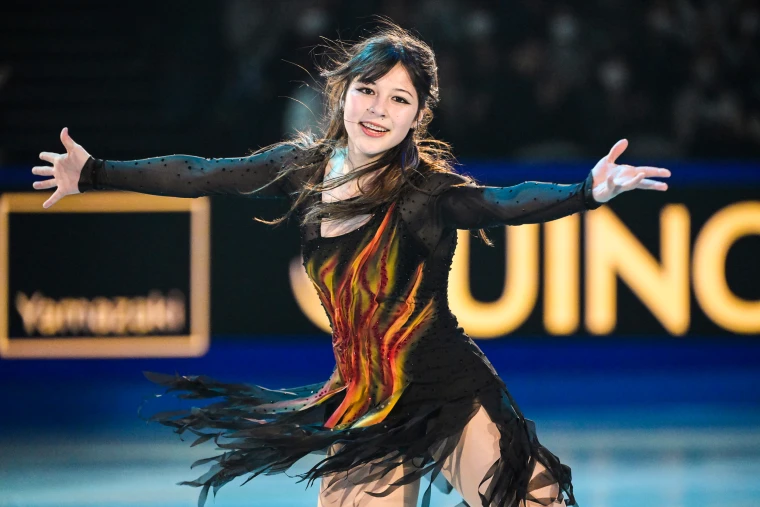
The rise of Alysa Liu is rapidly reshaping the commercial outlook of figure skating, with governing bodies reporting a notable surge in participation and a renewed focus on monetising the sport’s global appeal.
Since capturing double Olympic gold at the Milan Games, Liu has become a mainstream global celebrity—amassing over eight million social media followers, appearing at major fashion and entertainment events, and becoming one of the most visible athletes in winter sports.
Now, the sport is working to translate that momentum into long-term growth.
Participation surge across new markets
U.S. Figure Skating reports a sharp increase in grassroots participation, with learn-to-skate programmes seeing an estimated 20–30% rise in sign-ups in the weeks following the Olympics.
That growth far exceeds typical Olympic cycles, where increases tend to hover around 10% or less.
Notably, the surge is not confined to traditional skating regions. States such as Kansas, Indiana, and Alabama have seen unexpected spikes, while rinks in cities like Albuquerque have reported record enrolment levels.
A commercial opportunity built around a star
Executives believe Liu represents a rare opportunity to elevate the sport’s global profile.
“She’s transcended what we’ve seen from previous Olympians,†said USFS CEO Matt Farrell.
Her influence is already being felt beyond participation metrics, with the sport gaining visibility across mainstream media, fashion, and entertainment—an ecosystem that governing bodies hope to convert into commercial partnerships.
Broadcast and sponsorship reset underway
At the global level, the International Skating Union (ISU) has launched a new request-for-proposal process for combined sponsorship and broadcast rights across figure skating and speed skating.
The move is designed to capitalise on post-Olympic momentum and expand global distribution.
“Our goal is the widest possible viewership,†said ISU director general Colin Smith. “We don’t want to be behind too many paywalls.â€
The ISU is also exploring new markets, with growing interest reported in countries such as Mexico, Indonesia, and Thailand—regions identified as high-potential growth areas.
Music, media, and the next frontier
One of the biggest commercial hurdles remains music licensing, which has historically limited how figure skating content is distributed online.
Clearing music rights has proven complex and costly, restricting highlights and social content—especially on digital platforms where short-form clips drive engagement.
To address this, the ISU and USFS are prioritising stronger partnerships with record labels, with the aim of transforming skaters into cultural and even promotional partners for music artists.
Liu’s routines, for example, have driven increased streams for featured songs—an early indicator of the sport’s crossover potential.
Balancing innovation and athlete longevity
As the sport grows, governing bodies are also considering rule changes aimed at extending athletes’ careers.
There is increasing discussion about reducing the emphasis on extreme technical difficulty—particularly quadruple jumps—which have been linked to early burnout and short career spans.
Liu herself has publicly advocated for separating artistic and technical elements to better protect athletes’ longevity.
A sport at an inflection point
With Liu temporarily stepping away from competition after her Olympic triumph, the spotlight now shifts to the next generation of skaters competing at the 2026 World Figure Skating Championships in Prague.
But her impact is already clear: a surge in participation, a shift in commercial thinking, and a sport beginning to redefine its global identity.