
Iran’s participation in the 2026 FIFA World Cup has been thrown into profound uncertainty following Saturday’s joint military strikes by the United States and Israel — attacks that killed Supreme Leader Ayatollah Ali Khamenei and left more than 200 people dead, according to the Iranian Red Crescent Society. The strikes came approximately 100 days before the opening kickoff of a tournament the United States is co-hosting.
Nothing in the history of the World Cup comes close to what is unfolding now.
“We Cannot Look Forward to the World Cup With Hope”
Iran is scheduled to play three group-stage matches on American soil — against Belgium, New Zealand, and Egypt. The final of those fixtures, against Egypt in Seattle, had already been designated by FIFA as the tournament’s controversial “Pride Game.” If Iran and the United States each finish second in their respective groups, the two nations would meet in the round of 16 on July 3 in Dallas.
Mehdi Taj, president of the Iranian Football Federation, told the Iranian sports platform Varzesh3 on Saturday: “What is certain is that after this attack, we cannot be expected to look forward to the World Cup with hope.”
The Asian Football Confederation and the Iranian federation did not respond to multiple requests for comment.
FIFA General Secretary Mattias Grafström, who was attending the annual International Football Association Board meeting as the violence unfolded, attempted to strike a measured tone. “I read the news the same way as you did this morning,” he said in a press conference Saturday. “We had the [IFAB] meeting today and I think it’s a bit premature to comment on it in detail. But of course we will monitor the developments around all issues around the world. We had the final draw in Washington where all teams participated and of course our focus is to have a safe World Cup with everybody participating.”
FIFA on Sunday directed further inquiries back to those same comments.
Meanwhile, Andrew Giuliani, who heads the White House’s World Cup task force, posted a statement on social media openly celebrating the strikes: “The largest state sponsor of terrorism in my lifetime is dead.” He added: “We’ll deal with soccer games tomorrow — tonight, we celebrate [Iranians’] opportunity for freedom.”
Why This Is Unlike Anything in World Cup History
Sports have long intersected with geopolitics, and football has not been immune. But historians and observers scrambling for comparable precedents are finding that none fully apply to what is happening now. Three key dimensions make the 2026 situation categorically different from anything the tournament has faced before.
The Host Nation Is the Aggressor
In every prior instance where geopolitical conflict touched the World Cup, the tournament’s host country remained a neutral party. In 1986, when Argentina met England in Mexico City just four years after the Falklands War — a match that became one of football’s most politically charged encounters — the host nation, Mexico, had no stake in the conflict. The war itself was over. The players took the field on neutral ground.
In 2022, FIFA expelled Russia from the qualifying play-offs following its invasion of Ukraine. That decision, while historic, again involved FIFA acting against an aggressor that was not the host country. Qatar, as host, played no role in the conflict.
Now, for the first time in the tournament’s 96-year history, one of the three host nations — the United States — has carried out a military strike against a participating team’s country fewer than 100 days before that country is scheduled to play matches on American soil. The foundational premise of the World Cup — that host nations extend welcome and guarantee safety to all participating nations — has been shattered in a manner that has no historical equivalent.
Active, Ongoing Conflict — Not Historical Grievance
The 1986 Argentina-England match is the canonical example of geopolitics meeting football. Maradona’s “Hand of God” goal has been interpreted through that lens for decades. But by the time the players walked onto that pitch in Azteca Stadium, the Falklands War had been over for four years. Diplomatic tensions persisted; the wounds were raw. The conflict itself, however, was closed.
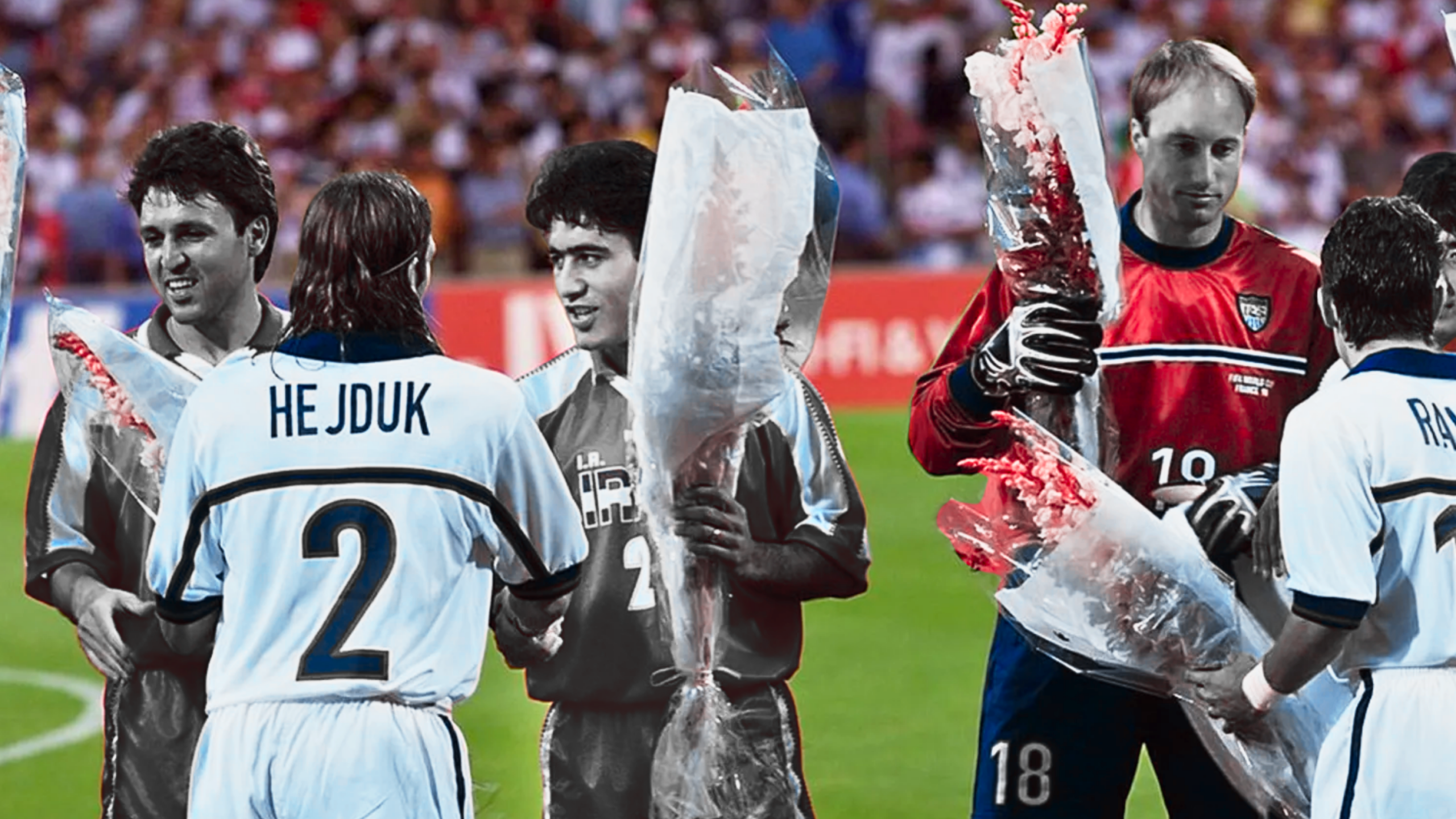
The same distinction applies to the 1998 World Cup in France, when the United States and Iran faced each other in the group stage during a period of deep diplomatic estrangement. Iranian players famously presented their American counterparts with white flowers before kickoff — a gesture of peace at a moment defined by political hostility. But there was no active armed conflict between the two nations. No recent strikes. No fresh casualties.
What confronts FIFA today is a live crisis: the strikes occurred Saturday, the dead are still being counted, and counter-attacks from Iran have already killed at least 10 people in Israel. Asking the Iranian national team to board a plane for the United States in this environment is not a diplomatic abstraction — it is a concrete demand being placed on citizens of a country that the host nation attacked days or weeks prior.
The Assassination of a Head of State Changes Everything
No World Cup match has ever been played in the immediate aftermath of the assassination of a participating nation’s head of state — let alone an assassination carried out by one of the host countries.
The killing of Ayatollah Ali Khamenei transforms this from a geopolitical crisis into a national tragedy of the first order. Iran will be a country in mourning, in political upheaval, and potentially in the early stages of open warfare. The idea of its footballers competing in a festive international tournament on the soil of the country that orchestrated that killing — while that country’s task force chief celebrates the supreme leader’s death on social media — is not merely diplomatically uncomfortable. It is, by any reasonable measure, an entirely new kind of problem for international sport.
The Yugoslavia Comparison — and Why It Differs
The closest structural precedent may be the exclusion of Yugoslavia from UEFA Euro 1992. Ten days before the tournament began in Sweden, the United Nations imposed sanctions on Yugoslavia amid the brutal Balkan wars. UEFA and FIFA acted swiftly, removing Yugoslavia from the competition.
The parallel is instructive — but limited. Sweden, the host nation, was not a party to the Balkan conflict. The decision to exclude Yugoslavia was made by international governing bodies responding to UN resolutions, not by a host country that had itself struck a participating nation. The Yugoslavia case shows that football can and does respond to war. It does not show how football responds when the host is the belligerent.
A Tournament Already Strained by Politics
The 2026 World Cup was already navigating political headwinds before Saturday’s events. Iran was among a small number of participating nations whose citizens face restrictions under U.S. travel bans; while the Trump administration indicated it would issue carve-outs for players, staff, and family members, Iranian fans had no such exemption — meaning supporters would have been largely unable to attend matches even before the strikes.
U.S. President Donald Trump received the inaugural FIFA Peace Prize in December 2025. FIFA President Gianni Infantino, who has cultivated a close personal relationship with Trump, was photographed wearing a Trump-branded “USA” hat at a recent Board of Peace meeting.
The ripple effects of Saturday’s attacks are already spreading through international sport. The Asian Football Confederation postponed continental club playoff matches. The Qatar Football Association suspended all league fixtures. A cricket match in Abu Dhabi between England and Pakistan was cancelled.
Iran’s women’s national team is currently competing in the AFC Women’s Asian Cup in Australia. Head coach Marziyeh Jafari — named AFC Coach of the Year in 2025 — declined to address the events when approached by reporters. “I don’t think we should talk about these matters at all right now,” she said through a translator. “There’s a team here for a very important competition that matters to these women and I think those should be the questions.”
What Comes Next
FIFA has offered no timeline for a decision on Iran’s participation, no emergency protocols, and no statement beyond Grafström’s measured remarks from Saturday. The organization that awarded its inaugural Peace Prize to the president of a country that has now struck a World Cup participant — with the tournament 100 days away — faces pressure unlike anything it has previously encountered.
History offers guides for pieces of this crisis: Yugoslavia teaches that expulsions happen; 1998 shows that rivals can play; 1986 proves that wounds can be carried onto the pitch. But no prior chapter covers what happens when the host pulls the trigger.
That chapter is being written now.