
In elite track and field, the margins between success and failure are measured in hundredths of a second. Behind the scenes at the World Athletics Indoor Championships, however, the margins are measured in cable runs, RF frequencies and the precision of a perfectly routed audio signal.
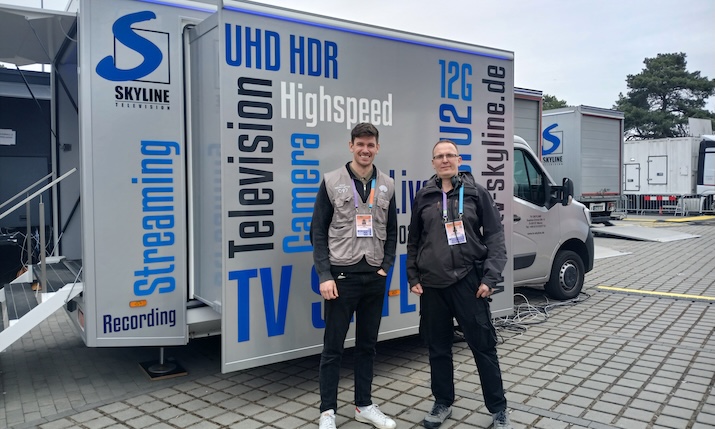
At the heart of it all is TV Skyline, operating as a critical service provider to both Tata Communications and Host Broadcast Services (HBS). On site inside the Kujawsko-Pomorska Arena, the German-based company has assembled a small army: 25 technicians, four full production galleries and a machine capable of delivering roughly 12 hours of daily content.
This is not just a broadcast operation. It is a logistical chess match.
“The first gallery is for the integrated feed… then we have a gallery for horizontal jumps, one for high jumps, and the fourth for shot put and pole vault,†explains René Meixelsberger. “Basically one gallery for two competitions.â€
Four galleries. Four directors. Four vision mixers. Four audio engineers. Four parallel worlds — all working in sync.
The audio puzzle
If the camera layout is the visible spectacle, the audio setup is the hidden headache.
With only two permanently installed audio consoles inside the trucks but four dedicated audio engineers demanding control, TV Skyline had to rethink its workflow.
The solution? Expansion — and improvisation.
“We set up two additional desks in the trucks… this was, audio-wise, the main challenge.â€
In a sport where silence can be as telling as sound, audio precision is non-negotiable. Every jump, every footstep, every reaction depends on a delicate balance — and in Toruń, that balance required engineering flexibility.
A web of 38 cameras — and 64 microphones
The numbers alone hint at the scale:
- 38 cameras
- 64 non-camera-mounted microphones
- 80 SMPTE fiber drums
- 7 RF wireless cameras
For a compact indoor venue, that’s an immense technical footprint.
And yet, the challenge wasn’t just scale — it was aesthetics.
“HBS wanted a clean look in the arena,†Meixelsberger says. “You can’t see any cable in the infield.â€
Achieving that meant disguising an ocean of wiring beneath carpets and carefully planned cable paths — a quiet victory that viewers at home will never notice, but would immediately feel if it were absent.
RF roulette
Wireless cameras are always a gamble. In Poland, with limited frequency availability, that gamble becomes even riskier.
TV Skyline pushed seven RF cameras into the spectrum — a near-maximal use of available bandwidth.
“We barely managed to get all seven cameras in the available frequency band,†Meixelsberger admits.
The key to success? Coordination — and early planning with HBS and local organizers. One misstep, and the entire wireless setup could collapse under interference.
The central nervous system
To manage this wireless-heavy operation, TV Skyline deployed its R10 truck as a central hub for all RF receivers — essentially turning it into the nerve center of the broadcast.
Alongside it, OB11 and OB12 trucks handle core production, while G10 and G2 support additional galleries.
It’s a distributed system with a single goal: seamless coverage.
21 desks, 1 event, countless voices
With 670 athletes from 113 countries, the global reach of the event extends into the commentary booths.
There are 21 commentary positions available — each feeding into a system that allows real-time switching between feeds.
“Each gallery can choose the commentator and use it for the feed,†Meixelsberger notes.
In practice, that means a fluid, dynamic commentary structure — where voices shift depending on the event, the discipline, and the story unfolding in real time.
EVS, highlights and the digital layer
The broadcast is no longer just about live coverage.
With 11 EVS replay systems integrated into HBS’s digital media hub, TV Skyline is also powering highlight creation and in-stadium content delivery.
A dedicated IPDirector in the venue can access all systems, curate clips, and push them directly to arena screens — giving fans inside the stadium a second layer of storytelling in real time.
Meanwhile, rights holders receive edited content through a robust backend editing and distribution setup.
The bigger picture
The World Athletics Indoor Championships may last only three days, but the infrastructure behind it reflects a broader trend in sports broadcasting: increasing complexity, increasing integration, and increasing expectations.
And yet, for TV Skyline, the chaos resolves into something simple.
“If there’s any challenge, the solution is never too far away.â€
It’s a fitting mantra for a sport defined by precision — where milliseconds matter on the track, and milliseconds of signal latency matter just as much behind the scenes.