
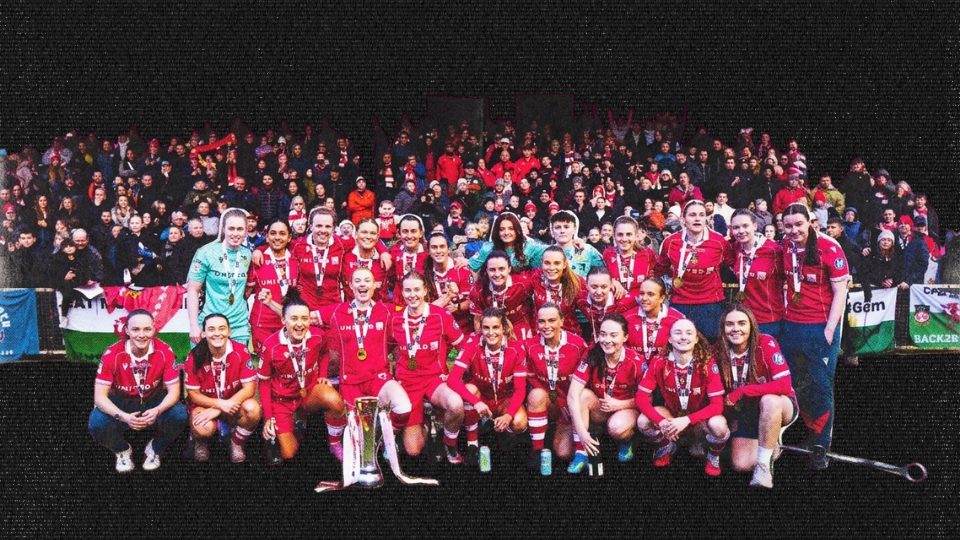
In front of a crowd at STÅK Cae Ras, Wrexham AFC Women beat Cardiff City 4-1 to win the Genero Adran Premier title. The scoreline felt routine by the final whistle. What it meant was not. For the first time in the club’s history, Wrexham had qualified for European competition — the UEFA Women’s Champions League qualifying rounds.
The men’s side is still trying to reach the Premier League. The women got to Europe first.
This is worth sitting with. Ryan Reynolds and Rob McElhenney spent over £56 million building a football club into a global brand. Three consecutive promotions, a hit documentary, partnerships with United Airlines and Meta, a valuation that has reportedly climbed past £100 million. The story has been told, retold, and greenlit for a fourth documentary season. And yet the single most significant sporting milestone the club has reached in the modern era — European football — came from a side that was, just eight years ago, playing in the second tier of the North Wales Women’s Football League.
“They disbanded in 2016 because they couldn’t fill a squad. They reformed in 2018. Seven years later, they’re in Europe.”
The women’s team’s path to this moment is almost comically compressed. They first dissolved mid-season in 2015-16, unable to maintain a full roster. They reformed in 2018 through the club’s community foundation, entering the lowest available tier. When Reynolds and McElhenney arrived in late 2020, one of their first moves was a £50,000 injection into the women’s programme — modest by the standards of what followed, but a signal. In June 2023, the club signed ten players to semi-professional contracts, the first such deals in Welsh women’s football. That autumn, they entered the top flight for the first time. By March 2026, they were champions of it.
The pace of that ascent — lower division to league title in seven seasons — is the kind of trajectory that the men’s project, for all its resources and global attention, has not yet matched. Wrexham AFC men have not played European football since the 1970s. The women have never played it at all. Until now.
The path
2016Women’s team dissolves mid-season, unable to field a full squad
2018Reformed by Racecourse Community Foundation; enter bottom tier of North Wales Women’s League
2021Reynolds and McElhenney invest £50k into the women’s programme
2023Ten players sign semi-pro contracts; team earns promotion to Adran Premier — the Welsh top flight
Feb 2026Win the Adran Trophy, defeating Cardiff City in the final
Mar 2026Beat Cardiff City 4-1 to win the Adran Premier title; qualify for UEFA Women’s Champions League
The qualification itself comes with asterisks worth noting. Wrexham will enter the Champions League at the first qualifying round — a mini-tournament format against other national champions, the majority of whom come from better-funded leagues. The road to the league phase, where the genuine heavyweights compete, will be steep. Recent Welsh champions have faced clubs like FC Twente and Shelbourne in early rounds. The gap in resources and infrastructure is real.
But that framing also misses something. The investment case for the women’s programme was never about immediate continental glory. It was about building something sustainable in a league that, until recently, was entirely amateur. The club bought their home ground — The Rock in Rhosymedre — outright in August 2025. Their training kit is sponsored by Blake Lively’s beverage company. Attendances and interest have grown alongside the men’s side. The infrastructure is there in a way it simply wasn’t a decade ago.
“Reynolds and McElhenney wanted to build a football club, not just a men’s team. On March 29, the women proved they understood that assignment.”
There is a version of this story that frames the women’s success as a footnote to the larger Wrexham narrative — the celebrity takeover, the promotions, the documentary. That version is wrong. The women’s title is the cleanest proof of concept the project has produced: that genuine investment in infrastructure, professional contracts, and institutional stability can take a dormant programme to the top of its league within a single generation of players.
The men’s team has the bigger budget, the bigger audience, and the bigger ambition. The women’s team has European football. For now, they’re ahead.