
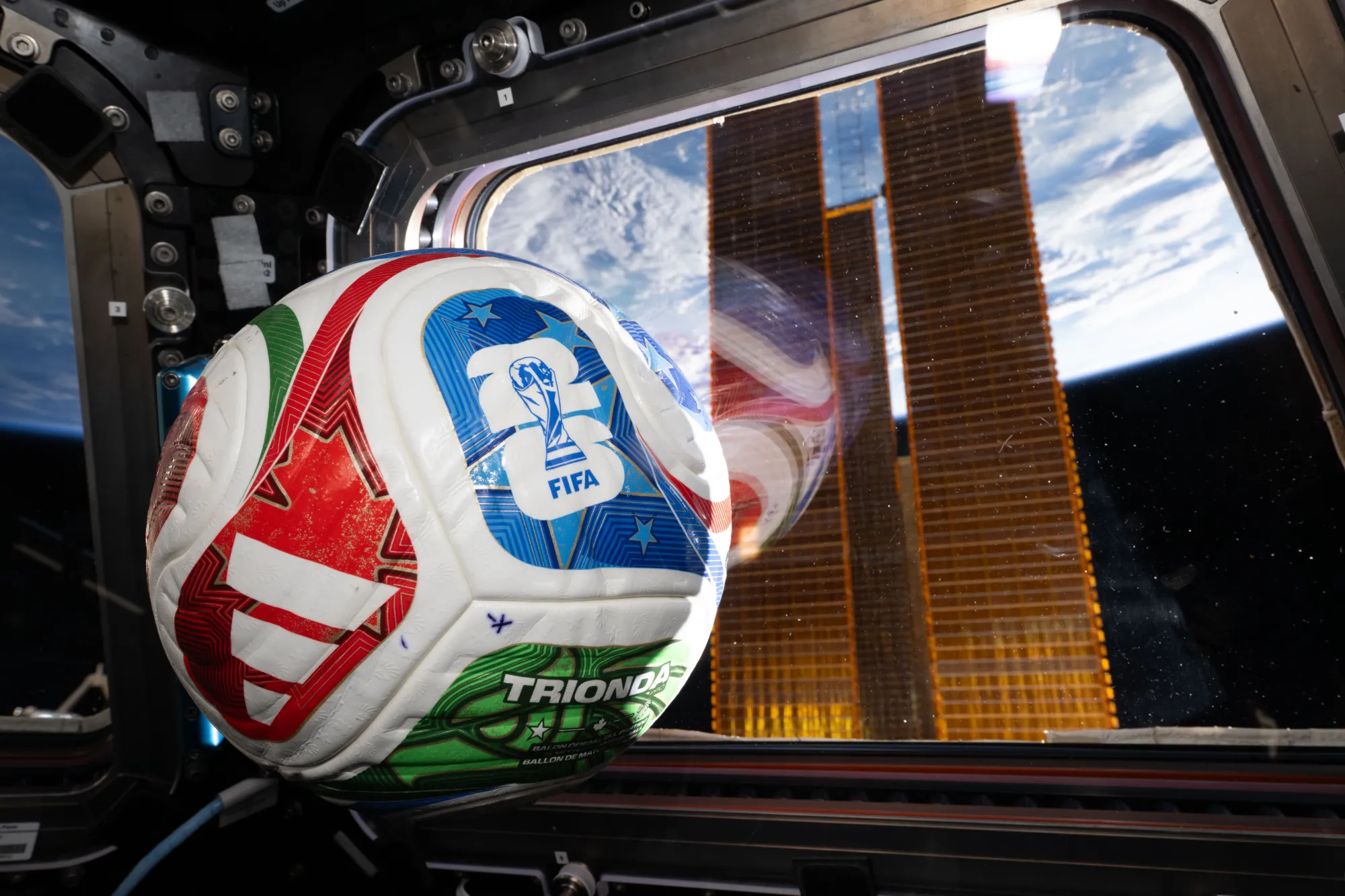
As the 2026 FIFA World Cup captures the attention of football fans around the globe, NASA is using the tournament to showcase how space exploration and scientific research can influence the world’s most popular sport.
From June 11 to July 19, NASA is hosting an interactive exhibit at the FIFA Fan Festival™ Houston, where visitors can discover how research conducted aboard the International Space Station (ISS) benefits everyday life on Earth and explore future missions through the Artemis program.
NASA brings space exploration to World Cup fans
Located in Houston’s East Downtown district, the NASA exhibit is open free of charge throughout the tournament.
One of the major highlights will take place on June 20, when Johnson Space Center Director Vanessa Wyche introduces selected members of the Artemis II crew following their historic mission around the Moon. The astronauts will participate in World Cup-related activities before the Netherlands-Sweden match in Houston and later appear on the Fan Festival’s main stage to share their experiences with supporters.
The science behind the football
NASA’s relationship with the World Cup extends far beyond fan engagement activities.
In partnership with the ISS National Laboratory, researchers used the microgravity environment aboard the International Space Station in 2019 to investigate how the internal mass distribution of a football affects its motion, stability and rotation.
The findings improved scientists’ understanding of how embedded technologies inside match balls can influence performance during play.
The research later contributed to studies used in the development and evaluation of footballs for major international competitions, including FIFA World Cup tournaments.
Why sensors matter
Since 2022, Adidas has integrated electronic sensors into official match balls used in major competitions.
These sensors provide real-time information on speed, position and ball contact, supporting officiating decisions and enhancing broadcast technology.
However, the technology also introduces additional mass inside the ball. Even small variations in weight distribution can alter how the ball behaves in flight.
NASA’s space-based experiments helped researchers better understand how these internal components affect stability and spin under real-world conditions.
From the ISS to the pitch
The work builds upon earlier aerodynamic studies conducted by engineers at NASA’s Ames Research Center in California.
Using wind tunnel testing, researchers examined the Adidas Brazuca ball developed for the 2014 FIFA World Cup, focusing on the “knuckleball” effect—a phenomenon in which low-spin shots move unpredictably due to unstable airflow around the ball’s seams.
Scientists found that factors such as panel design, seam depth and surface texture significantly influence whether a ball curves, dips or maintains a straight trajectory.
Space science meets football
NASA and Adidas are now bringing these concepts to life through a STEM demonstration that compares how footballs with different internal weight distributions behave in microgravity.
The experiment illustrates that the same laws of physics governing spacecraft and satellites also shape the flight of a football watched by billions of people around the world.
Through decades of International Space Station research and technologies developed for human exploration, NASA continues to demonstrate how discoveries made for space can create tangible benefits on Earth—including for athletes, officials and fans of the beautiful game.