
The assumption felt logical, almost inevitable.
Take the best athletes from the NFL, drop them into flag football — a non-contact, space-driven variation of the sport — and dominance should follow. After all, speed is speed. Talent is talent.
Saturday at BMO Stadium shattered that illusion.
Team USA’s national flag football squad didn’t just beat teams filled with NFL stars at the Fanatics Flag Football Classic. They exposed a gap — technical, tactical, and philosophical — that many didn’t believe existed.
The final tally across three games: 106-44.
The message: This is a different sport.
A Different Language of Football
From the opening snap, the contrast was stark.
NFL concepts — timing routes, pocket structure, physical leverage — struggled to breathe in a game built on instant separation, lateral explosiveness, and spatial manipulation. The U.S. national team didn’t overpower their opponents. They outmaneuvered them.
Even Tom Brady, arguably the most cerebral quarterback in football history, acknowledged the disconnect.
“We were trying to play more NFL football,†Brady admitted. “But things happen pretty quick out there… we’re probably way behind.â€
That gap showed up everywhere: missed flag pulls, defensive overcommitment, penalties born from instinct rather than understanding.
Flag football, in this context, isn’t a stripped-down version of the NFL game. It’s a specialized discipline with its own ecosystem.
The Statement Game — And the Statement Player
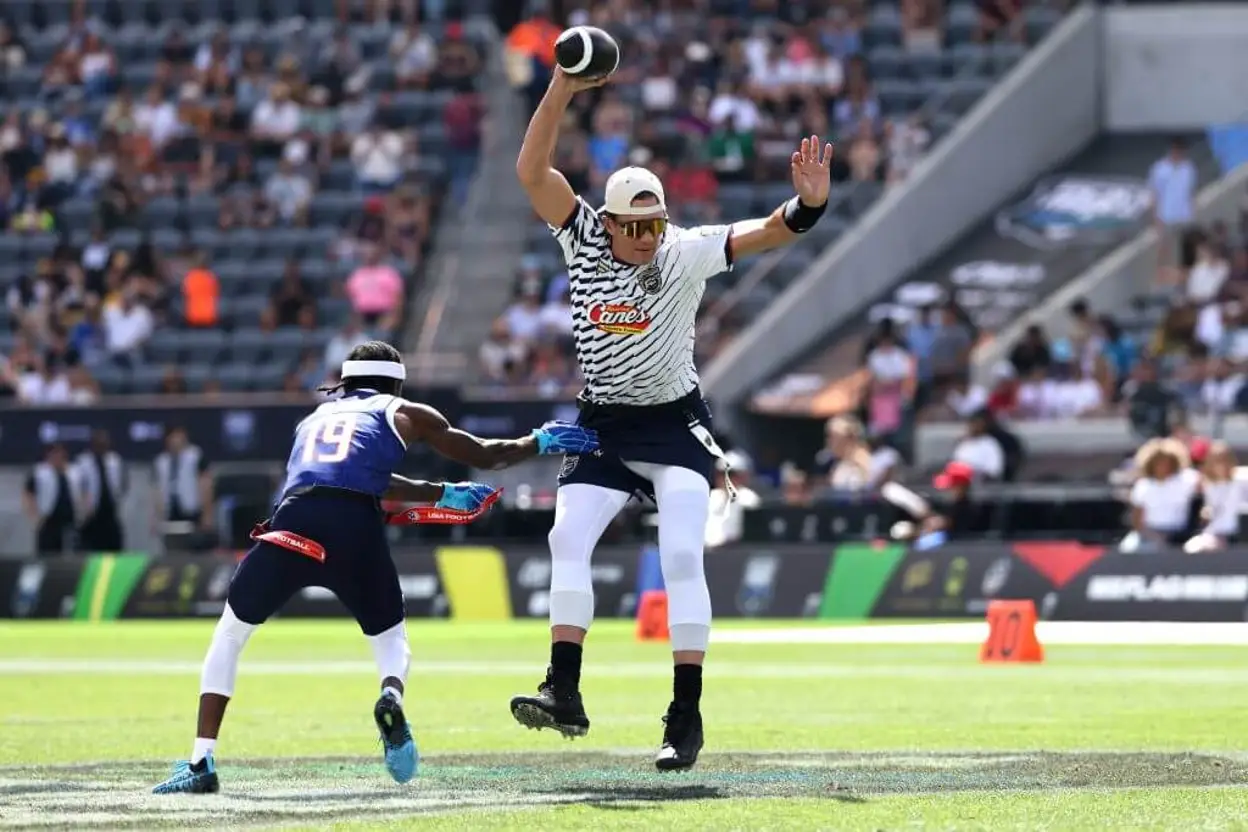
No one embodied that reality more than quarterback Darrell “Housh†Doucette.
Two years ago, he became a viral talking point for suggesting he was a better flag football quarterback than Patrick Mahomes — a claim widely mocked outside the flag football community.
Saturday reframed that conversation.
Doucette delivered a near-flawless performance:
- 8-for-8 passing, 3 TDs
- 76 rushing yards, 3 TDs
- 79 receiving yards
- Tournament MVP
But the numbers were only part of it. His command of tempo, spacing, and improvisation illustrated something deeper: mastery of a different game language.
After the win, emotion overtook him — not as validation, but as vindication.
“We wanted to show that we are flag football… not to be overlooked.â€
Why NFL Talent Didn’t Translate — Yet
On paper, the NFL rosters were absurdly talented.
Quarterbacks like Joe Burrow and dynamic playmakers like Odell Beckham Jr. produced flashes — Beckham’s one-handed touchdown grab being the highlight of the day.
But flashes weren’t enough.
The structural issues were clear:
1. No Contact, No Control
Defenders like Luke Kuechly built careers on physical disruption. In flag football, that tool disappears.
“Our inability to put our hands on those guys made it very difficult,†Kuechly said.
2. Micro-Space Over Power
Flag football compresses decision-making into seconds and inches. The national team operated in tight spaces with short-area quickness, not long-speed dominance.
3. Scheme Mismatch
NFL route trees and protections looked slow — even clunky — against opponents running systems designed purely for flag.
This wasn’t about athleticism. It was about adaptation speed.
The Olympic Subtext
All of this lands in a much bigger context: the sport’s inclusion in the 2028 Summer Olympics.
The underlying question is no longer hypothetical:
Should NFL players represent Team USA?
Saturday suggested a more complicated answer.
Team USA head coach Jorge Cascudo didn’t dismiss the NFL’s potential — far from it.
“If they put the work into this, they’re going to be the best,†he said.
But that “if†is doing heavy lifting.
Because right now, the incumbents — the specialists — hold a decisive edge.
A Window Into the Future of the Sport
What happened at BMO Stadium wasn’t just an exhibition result. It was a proof of concept.
Flag football is evolving into:
- A standalone high-performance sport
- A system that rewards specialization
- A discipline where experience outweighs raw pedigree
For the NFL stars, this was a lesson.
For Team USA, it was a declaration.
And for the rest of the world heading toward 2028, it was a warning:
You’re not playing football. You’re playing flag football.