
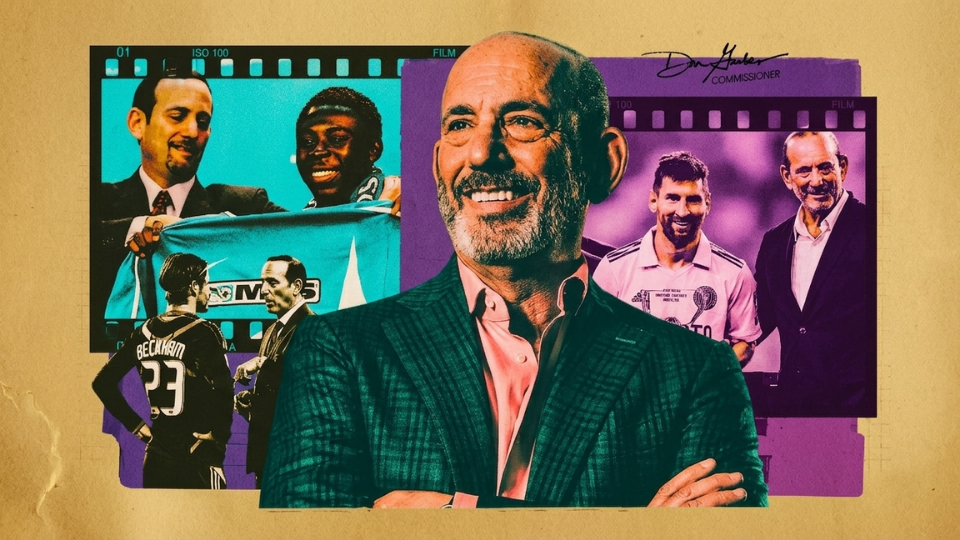
When Don Garber was named MLS commissioner in August 1999, the headlines were not kind. An NFL marketing executive with no soccer background taking charge of America’s top flight? Sports editors across the country panned the decision. What they didn’t know — what they couldn’t see — was that the kid from Bayside, Queens had spent his entire career doing exactly one thing: finding value where no one else was looking.
He pumped gas at Barney’s Gulf station. He folded newspapers just right so he could toss them from his Stingray bike. After college at SUNY Oneonta, he spent eighteen months sleeping in a Ford van, tending bar and laying irrigation lines across the U.S. and Mexico. When his mother clipped a job ad from the newspaper to lure him home, he took it — a PR role at a tuition-free watchmaking school for veterans — and never stopped moving forward.
“You cannot take the Queens out of anybody who truly was born and bred there. It is a part of your DNA.”— Don Garber
At NFL Properties, surrounded by Ivy League MBAs, the Queens kid kept his head down and learned to sell. He dreamed up the NFL Experience — 100,000 fans showed up. He built NFL International from scratch into a 130-person global operation across six countries. When Robert Kraft called and asked if he could do the same for soccer in America, Garber didn’t hesitate. He saw what almost no one else saw.
“There was so much opportunity,” Garber later said. “You have to look and see what could be, as opposed to what’s right in front of you.”
II — The dinner table in Colorado
December 2000. A handful of owners gathered around the dining room table at Phil Anschutz’s ranch in Colorado. The league was bleeding money. Bankruptcy attorneys were on retainer. Multiple teams were failing at the gate. Garber and deputy commissioner Mark Abbott laid out two plans.
Plan A: keep doing what they were doing. “We’re going to lose more money,” Garber told the room, “and I can’t sit here today and tell you that three years from now we’d recommend going forward.” Plan B was harder: fold two teams, build soccer-specific stadiums, and launch a brand-new commercial engine to prove there was a market for the sport at all. “Quadruple down. Take some big risks.”
“We needed to sit in that famous dining room and not leave until everybody looked each other in the eye and said: are you in? If you’re in, I’m in.”— Don Garber, recounting that night
Some owners walked out. Three stayed: Anschutz, Kraft and Lamar Hunt. They absorbed the failing franchises. Miami and Tampa Bay were contracted after the 2001 season. And then came the masterstroke: the group purchased American television rights to the 2002 and 2006 men’s World Cups — which had no buyer at the time — along with the 2003 Women’s World Cup, for roughly $40 million. Soccer United Marketing was born.
“The creation of SUM was pivotal. Don’s a great salesman and he was able to convince us there was an opportunity to create an economic model that went beyond the league.” — Clark Hunt, FC Dallas owner
III — The numbers
10 → 30
Teams in the league
$10M → $500M
Expansion fee (Toronto ’06 → San Diego ’23)
$20 billion
Total league enterprise value
1 → 26
Soccer-specific stadiums
$2.5 billion
Apple TV+ deal (10 years)
12.1 million
2024 attendance — world’s 2nd highest
IV — The shot heard around the world
The turning point came in 2009. Garber walked onto the field in Seattle and looked up at 32,000-plus fans packed into the stands. “That was the shot heard around the world,” he said later. “Like, hey, there’s something here that everybody’s missing.” Soccer was suddenly sellable. The Sounders were team No. 15. A decade later, the league had grown to 24. Five more would follow by 2023.
The Designated Player rule, introduced in 2006, was the other engine. Beckham arrived at the Galaxy in 2007. Then Henry, Kaká, Ibrahimović, Vela, Insigne. And then, in the summer of 2023, Lionel Messi. Garber was in a meeting at league headquarters in New York when the call came confirming the greatest player of all time was coming to Inter Miami. “The thrill of the moment still caught me off guard,” he admitted. Twenty-five years earlier, he never could have imagined it.
“I never dreamed we would have 30 clubs, 12 million fans, 26 soccer-specific stadiums, and the best player in the world in Major League Soccer.”— Don Garber
V — Unfinished business
Garber’s contract runs through 2027. Owners have reportedly begun searching for his successor. But before he goes, there is MLS 3.0 — his most ambitious project yet: a switch to the European calendar, a restructured season and playoff format, and a roster-building model designed to compete with the continent’s elite. With the 2026 World Cup landing in North America, the window in front of him may be the biggest of his career.
Seattle Sounders owner Adrian Hanauer puts it simply: “Don has a superpower of relating to people in the way they need to be related to. He has a breadth of knowledge but also just a humanity about him — empathy, understanding what people are going through and what they need.” Nashville owner John Ingram adds: “He can be a tough New Yorker when he needs to be, but he’s also just a lovely person.”
The last piece of advice Garber received from NFL commissioner Paul Tagliabue when he left for MLS: “Keep the owners who hate you away from the ones who are undecided.” It’s the kind of line only a Queens kid would appreciate — sharp, practical, and delivered with a smile.
“We will be one of the dominant leagues in the world. The question isn’t if, it’s when. Nothing but time will stop that. We just have to be smart enough to earn it.” — Don Garber