
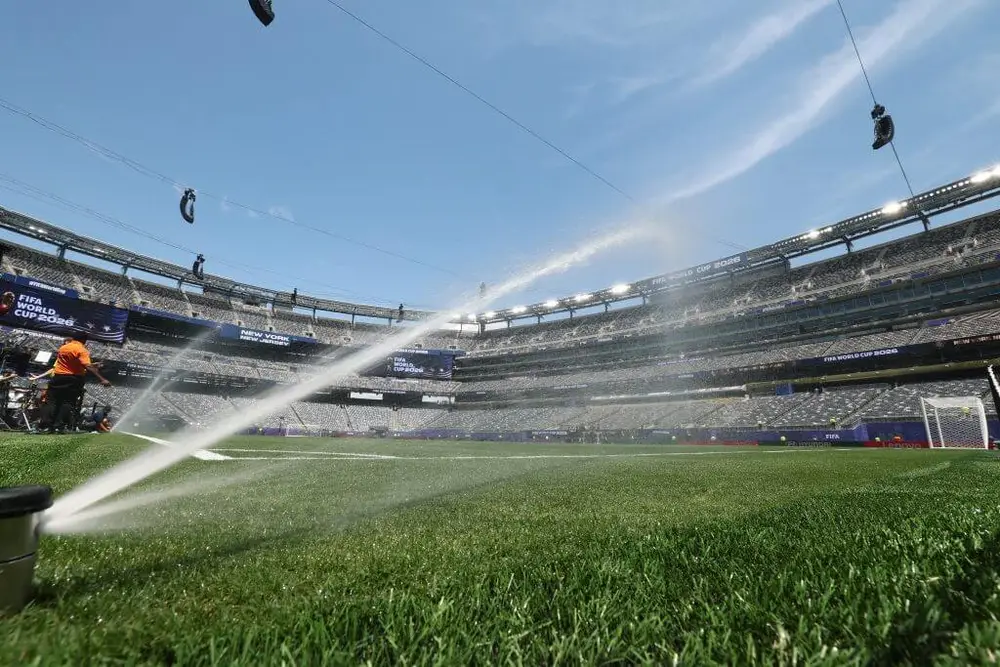
New Jersey and FIFA have clashed once again in the build-up to the 2026 FIFA World Cup final, this time over a plan to sell pieces of the grass from MetLife Stadium for more than $11 million.
The pitch at the New Jersey venue, which will host Sunday’s World Cup final, is being sold as a collectible through FIFA’s website. Small pieces of the grass will be encased in resin and shipped to buyers after the final on July 19.
The basic version is priced at $450, while additional versions are available for $900, $1,200 and $3,000. Each of the four editions is limited to 2,026 pieces. If all of the collectibles are sold, the total revenue could exceed $11.2 million.
The plan has angered New Jersey officials, who argue that state taxpayers helped fund the construction and maintenance of the pitch.
According to documents obtained by NorthJersey.com, the New Jersey Sports and Exposition Authority spent $13.04 million to bring the field up to FIFA standards. The spending included design work, field construction, pitch maintenance equipment and related services.
“As the Governor has said, New Jersey paid multiple millions for the total expense for the pitch at MetLife Stadium, so New Jersey taxpayers should share in any proceeds,” Steve Sigmund, a spokesperson for New Jersey Governor Mikie Sherrill, told The Athletic.
Republican members of the New Jersey Assembly also criticised FIFA, making the dispute a rare bipartisan issue.
“FIFA needs to get off our turf, literally,” Assemblyman Mike Inganamort said. “New Jersey taxpayers funded $13 million in upgrades to MetLife Stadium, including replacing the artificial turf with grass.”
He argued that the sale of the grass could represent a sale of state-owned property and should therefore benefit New Jersey taxpayers rather than FIFA.
However, sources close to FIFA and the joint New York-New Jersey host committee say FIFA is not solely responsible for the initiative. According to those sources, the host committee and FIFA agreed to sell only a small portion of the pitch — around five yards in total.
The host committee is expected to receive the majority of the proceeds, with FIFA receiving a smaller share for the use of its licensing rights. Sources say FIFA’s share is in the single-digit percentage range.
The disagreement is the latest in a series of disputes between Governor Sherrill and FIFA during the World Cup.
New Jersey and FIFA previously clashed over public transportation costs for fans travelling from Manhattan to MetLife Stadium. After Sherrill directed the state’s transit agency not to subsidise World Cup travel, the price of a round-trip train ticket for the 18-mile journey rose from $12.90 to $98.
Sherrill also criticised FIFA over the tournament’s projected revenues and high ticket prices, arguing that the governing body should do more to share the financial burden with host cities.
Another dispute emerged over the official tournament name of the venue. FIFA renamed MetLife Stadium New York New Jersey Stadium for the World Cup, prompting Sherrill to request that the order be reversed on one of the stadium’s major signs to better reflect New Jersey’s financial contribution and role as a host state.
The region has made significant investments in the tournament. New York and New Jersey have collectively committed hundreds of millions of dollars to hosting the World Cup, while New Jersey alone has contributed tens of millions to stadium improvements and other infrastructure projects.
The economic calculation is that the spending will be offset by an estimated $3.3 billion in regional economic impact.
But for New Jersey officials, the grass dispute has become symbolic of a broader concern: that FIFA is generating billions of dollars from a tournament heavily supported by public investment while local taxpayers are left to shoulder much of the cost.
With the World Cup final approaching, the pitch has become the latest battleground in an increasingly tense relationship between FIFA and its New Jersey host.