
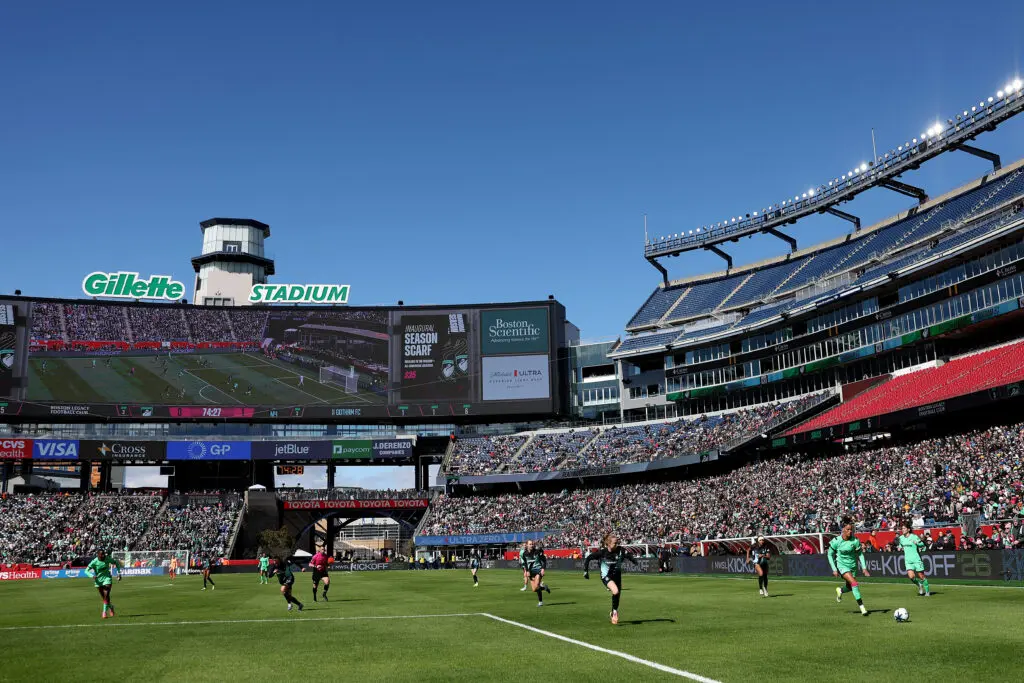
The crowd told the story before the league could.
When 63,004 fans packed Empower Field to watch Denver Summit FC’s home opener, it wasn’t just a record for the National Women’s Soccer League. It was a signal — one that’s becoming harder to ignore.
For a league that once fought simply to survive, the question has shifted. Not whether people will come, but how big the stage should be when they do.
And increasingly, that stage may look a lot like an NFL stadium.
From survival to scale
The NWSL’s growth has been steady, but the last two seasons have accelerated expectations.
Expansion sides in Denver and Boston didn’t just join the league — they redefined its ceiling. Boston Legacy drew more than 30,000 fans at Gillette Stadium. Denver doubled that.
Those numbers are forcing a rethink at the highest level.
Commissioner Jessica Berman has already acknowledged the league is exploring “options that may not have been on the radar before.†Translation: venues once considered too big may now be viable.
The final frontier: the championship
The NWSL Championship has evolved quickly — from a modest, localized event to something closer to a national showcase.
In 2019, it drew around 10,000 fans in Cary, North Carolina. By 2025, the final — played at PayPal Park — sold out and reached 1.18 million viewers across broadcast platforms.
Now comes the next logical step: scale.
Could the final fill a 60,000+ seat venue?
Recent evidence suggests yes — but not without trade-offs.
Intimacy vs. ambition
Keeping the final in a traditional soccer stadium offers certainty. A 20,000-seat venue guarantees a sellout, preserves atmosphere, and creates scarcity.
But it also caps growth.
A larger venue introduces risk — empty seats, diluted energy — but unlocks something the league increasingly values: reach.
It’s a classic inflection point. Stay premium and contained, or expand and risk imperfection in pursuit of something bigger.
Building an event, not just a match
The blueprint already exists.
The Super Bowl isn’t just about football. It’s a week-long spectacle, blending sport with entertainment, culture, and commerce.
That’s the model the NWSL is inching toward.
Recent finals have already expanded beyond 90 minutes — with awards shows, live podcasts, and fan activations turning the championship into a multi-day experience.
A larger venue would accelerate that shift. More tickets mean more fans, but also more inventory for sponsors, media, and partnerships.
The market is ready
Timing matters — and the league may be catching the wave at exactly the right moment.
According to industry projections, the global women’s sports market is set to surpass $3 billion in 2026. Investment, visibility, and cultural relevance are all trending upward.
The NWSL, now backed by a $240 million media rights deal across major broadcasters and streamers, is positioned to capitalize.
The question is no longer whether demand exists.
It’s whether the league is ready to fully embrace it.
What comes next
Several paths are on the table.
A rotating-host model — similar to the Super Bowl — would allow the league to plan years in advance and turn the final into a traveling destination event.
Rewarding top seeds with home-field advantage could inject competitive meaning and guarantee atmosphere.
Or the league could split the difference: larger venues within existing markets, balancing familiarity with scale.
None are without compromise.
But the direction is clear.
The NWSL has spent more than a decade building its foundation. Now, after record crowds and rising valuations, it’s confronting a new challenge — thinking big enough to match its own momentum.
Because if the last few months have proven anything, it’s this:
They built it.
And now, the fans are coming.