
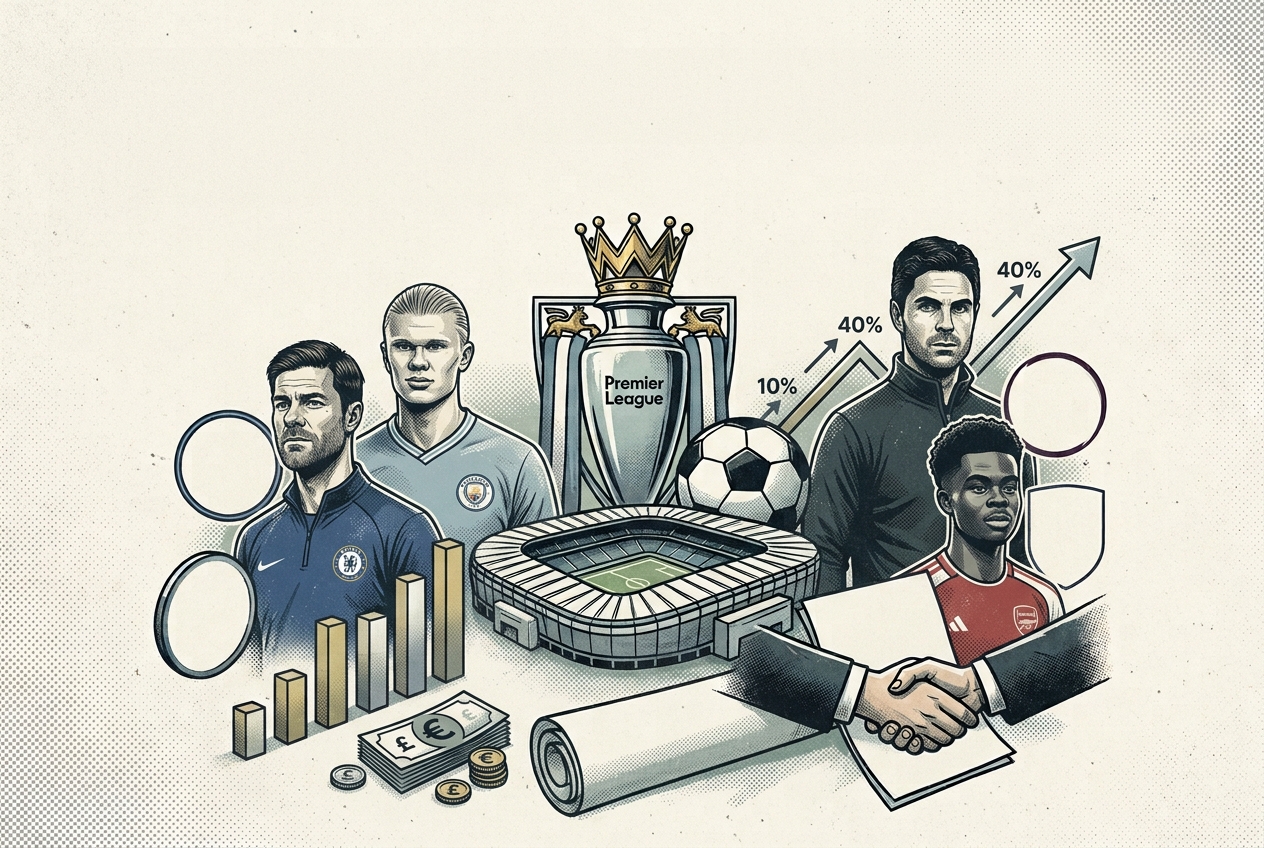
The 2026/27 Premier League season is beginning with much more than the usual focus on title races, transfers and new signings. Record revenues and transfer spending, a reshaped shirt sponsorship market, new broadcast technology, the Premier League taking greater control of its own media operation and the launch of a direct-to-consumer model are among the key business stories surrounding the new campaign.
Premier League clubs generated £6.8 billion in combined revenue in 2024/25, according to Deloitte. That figure is expected to rise to around £7.4 billion in the next financial benchmark, driven by commercial growth and the value of European competition.
Premier League clubs have already spent approximately €2.7 billion on transfers this summer, putting the competition on course for another record window.
The league’s economic impact extends far beyond club accounts. An EY study estimates that the Premier League will generate £33 billion in gross value added for the UK economy across the three seasons from 2025 to 2028, contribute £14.8 billion in tax revenues and support more than 107,000 jobs annually.
Last season, Premier League attendances reached a record 15.9 million, while the league estimates its global following at around 1.9 billion people across 189 countries. International broadcast exports are now worth close to £1.8 billion annually.
A new era for shirt sponsorship
One of the most visible changes this season will come on the front of club shirts.
The voluntary agreement banning gambling companies from appearing on the front of Premier League match shirts has now come into effect, closing a chapter in which betting brands became one of the dominant sponsorship categories in English football.
Gambling companies have not disappeared from the Premier League altogether. They can still appear on shirt sleeves, training wear and through other partnership assets.
However, the removal of betting brands from the premium front-of-shirt inventory has created opportunities for businesses in sectors such as financial services, fintech, artificial intelligence and technology.
Crystal Palace’s partnership with technology company Temporal, Everton’s deal with CMC Markets and Aston Villa’s agreement with Visit Rwanda illustrate the changing sponsorship landscape.
The challenge for clubs is to demonstrate that the newly available inventory can generate comparable value from mainstream global brands seeking reputation, customer acquisition and international reach.
Guinness remains a major global partner
Guinness enters the third season of its four-year agreement as the Premier League’s Official Beer, while Guinness 0.0 holds the corresponding non-alcoholic designation.
For the St James’s Gate-based brand, the Premier League provides access to one of the largest global audiences in sport.
The partnership, which began in 2024, was Guinness’s first global football partnership and has been built around football-viewing occasions across pubs, retail and the home.
The Premier League is particularly valuable for Guinness 0.0 as the brand continues to build the international profile of its non-alcoholic offering.
Ireland retains its 3pm advantage
The Irish market remains unusual in the Premier League’s international broadcast landscape.
Sky Sports, TNT Sports and Premier Sports hold the rights in the Republic of Ireland. Unlike the UK, Ireland is not subject to the traditional Saturday 3pm broadcast blackout.
As a result, Irish viewers can watch one live match from the Saturday 3pm window, giving them access to a fixture that cannot be shown live to viewers in Britain.
Premier Sports’ current Irish rights agreement runs through the 2028/29 season.
The arrangement continues to give Irish supporters one of the few instances in which the international market offers greater live Premier League choice than the domestic UK market.
Sky changes the way fans watch sport
Sky Sports is also using the return of the Premier League to introduce a new approach to television viewing.
Your Multiview allows customers to watch up to four live Sky Sports events simultaneously on a single television.
The feature addresses an increasingly common problem: Premier League matches frequently overlap with EFL and Scottish football, Formula 1, golf, tennis and other major sporting events.
Rather than forcing viewers to choose one event, broadcasters are increasingly turning the television screen into a personalised sports hub.
Sky’s offering will sit alongside its Sports Hub, live scores, statistics, clips and other interactive features.
The broadcaster says it will show more than 1,500 football matches across the Premier League, EFL, WSL and Scottish Premiership this season.
The competition between broadcasters is therefore becoming less about simply owning the rights and more about delivering the richest and most convenient viewing experience.
The Premier League becomes a broadcaster
One of the most significant long-term media developments is taking place behind the cameras.
From this season, the Premier League has brought its international media production and distribution operation in-house, ending the structure under which IMG and Premier League Productions had managed the operation for more than two decades.
The new operation will produce match feeds, highlights, studio programming and other content supplied to broadcasters around the world.
The move gives the Premier League greater control over its content, data, technology and relationship with supporters.
Strategically, the significance is considerable.
The Premier League is no longer simply selling broadcasters the rights to televise its competition. It is increasingly becoming a media organisation capable of creating, packaging and distributing its own content.
Premier League+ tests the direct-to-consumer model
The clearest example of this strategy is taking place in Singapore.
Supporters can now subscribe directly to Premier League+, with all 380 matches available live and on demand.
It represents the first major international experiment in which the Premier League has established a direct subscription relationship with its audience rather than relying entirely on a local broadcaster.
Singapore is currently a test market rather than the beginning of an immediate global rollout.
But broadcasters and rights holders around the world will be watching closely.
If Premier League+ can successfully acquire customers, manage subscriptions and distribute matches directly while building its own supporting content, the balance of power in future rights negotiations could change significantly.
Markets such as Ireland, where football engagement is particularly high, will inevitably be interested in how the experiment develops ahead of future rights cycles.
AI becomes part of the commercial strategy
Artificial intelligence is also becoming increasingly embedded in the Premier League’s digital ecosystem.
Microsoft is in the second year of a five-year agreement as the league’s Official Cloud and AI Partner, with its technology supporting the Premier League’s digital infrastructure and the fan-facing Premier League Companion.
The strategy includes personalised content, multilingual interaction, Fantasy Premier League assistance and greater use of real-time data and more than three decades of archived content.
The commercial objective is clear: deeper engagement.
The more the Premier League understands an individual supporter — their favourite club, players, Fantasy preferences, viewing habits and content interests — the greater its ability to personalise experiences and ultimately create additional commercial value.
Club valuations continue to rise
Liverpool’s latest minority investment provides another indication of the financial transformation of Premier League clubs.
Fenway Sports Group acquired Liverpool for £300 million in 2010. The club’s latest investment reportedly values Liverpool at more than £5 billion, or approximately $7 billion.
The new consortium will acquire roughly one-third of the club, while FSG will retain majority ownership and control.
The valuation demonstrates how Premier League clubs are increasingly viewed as more than football businesses.
They are global media, entertainment, data and consumer brands, which helps explain why private capital continues to target Premier League assets despite the enormous sums clubs are already spending on sporting success.
The bigger commercial story
Once the season gets underway, attention will quickly return to goals, managers, transfers and league tables.
But the bigger Premier League story is the commercial machine behind the football.
The 2026/27 season begins with record revenues and spending, a reshaped sponsorship market, increasingly sophisticated broadcast technology and a league taking much greater control over the production and distribution of its own content.
The most important development to watch may ultimately be happening thousands of kilometres away in Singapore.
If Premier League+ succeeds, the league will have demonstrated that it can move beyond being the world’s most valuable domestic football competition and become its own global broadcaster.
That could have major implications for Sky, TNT Sports and Premier Sports, for global partners such as Guinness, and eventually for how supporters in markets such as Ireland pay for and consume Premier League football.
The new season begins at the Emirates.
The next chapter in the business of the Premier League has already begun.