
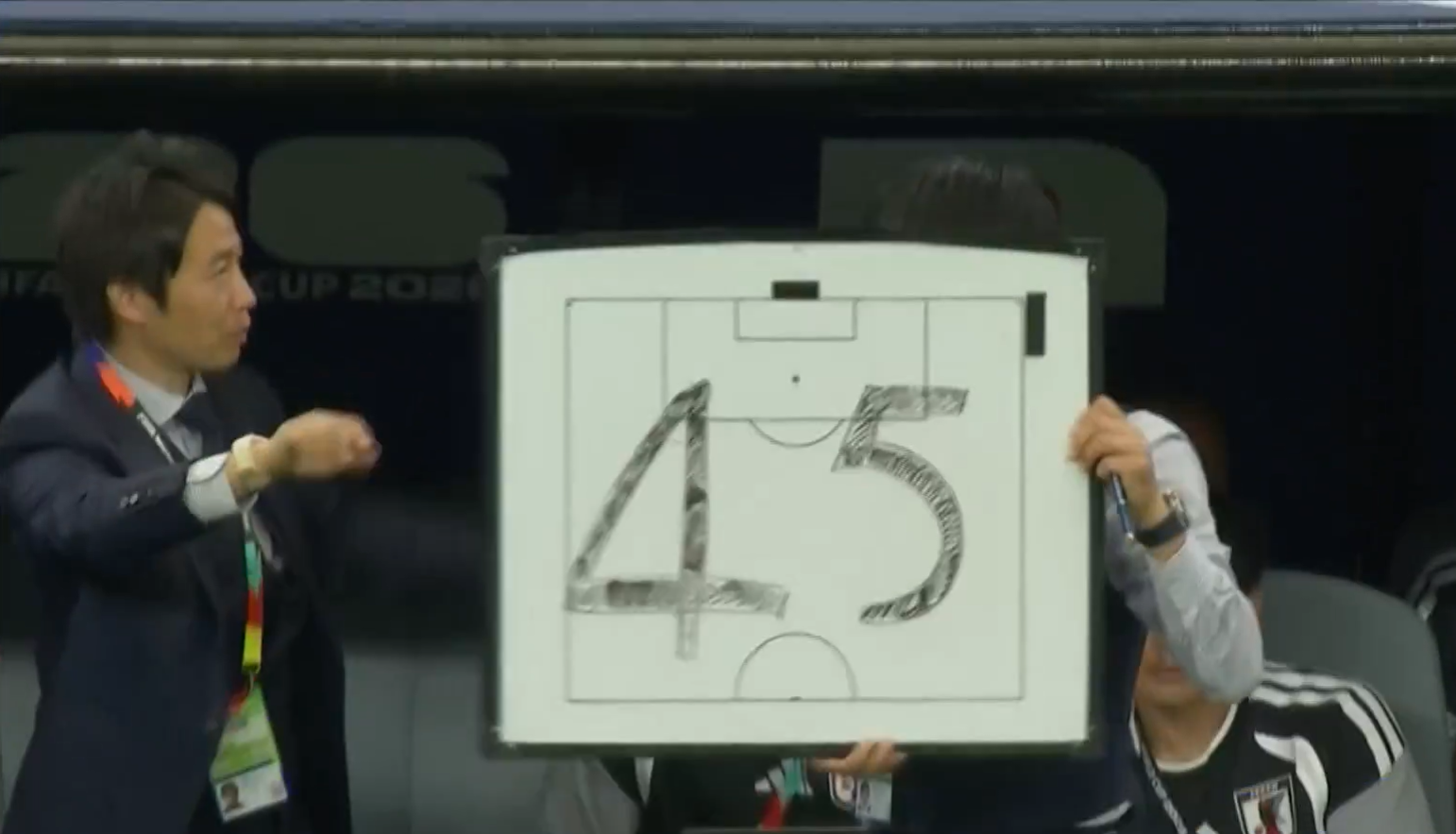
A photo from the 2026 FIFA World Cup has sparked an unexpected discussion about how football communicates on the pitch. The image, which quickly gained traction on social media, shows Japan’s coaching staff holding up a tactical board displaying a large “45” to relay instructions to players.
The scene prompted a wave of reactions online, with many fans jokingly wondering just how many set plays and tactical variations Japan had prepared. Beyond the humor, however, the image highlighted the contrast between football’s communication methods and those used in other major sports.
Football still relies on visual signals
In modern football, coaches typically communicate tactical changes through shouted instructions, hand gestures, or numbered tactical boards displayed from the touchline.
These methods are commonly used during substitutions, set-piece situations, and tactical adjustments. Japan’s “45” board likely referred to a pre-arranged tactical pattern or game plan understood by the players.
A comparison with the NFL
The contrast becomes particularly striking when compared to the NFL. In American football, helmet communication systems allow coaches to send instructions directly to designated players on the field.
As a result, tactical adjustments can be delivered almost instantly. Football, by comparison, remains largely dependent on visual and verbal communication, with FIFA regulations placing strict limits on in-game electronic communication between coaches and players.
Could technology be football’s next evolution?
Over the past decade, football has embraced innovations such as VAR, semi-automated offside technology, and increasingly sophisticated performance analytics. Yet communication between the bench and players remains largely traditional.
Supporters of greater technological integration argue that controlled communication systems could improve tactical clarity and reduce confusion during matches. Traditionalists, meanwhile, believe football’s fluid nature and emphasis on player decision-making should be preserved.
One image, one bigger question
At first glance, Japan’s “45” tactical board may seem like nothing more than an amusing World Cup moment. Yet it raises a broader question about the future of the sport: should football adopt more advanced communication technology, or should it continue to rely on the human element that has long defined the game?
For now, there is no clear answer. But one of the tournament’s most talked-about images has reignited a debate that is unlikely to disappear anytime soon.