
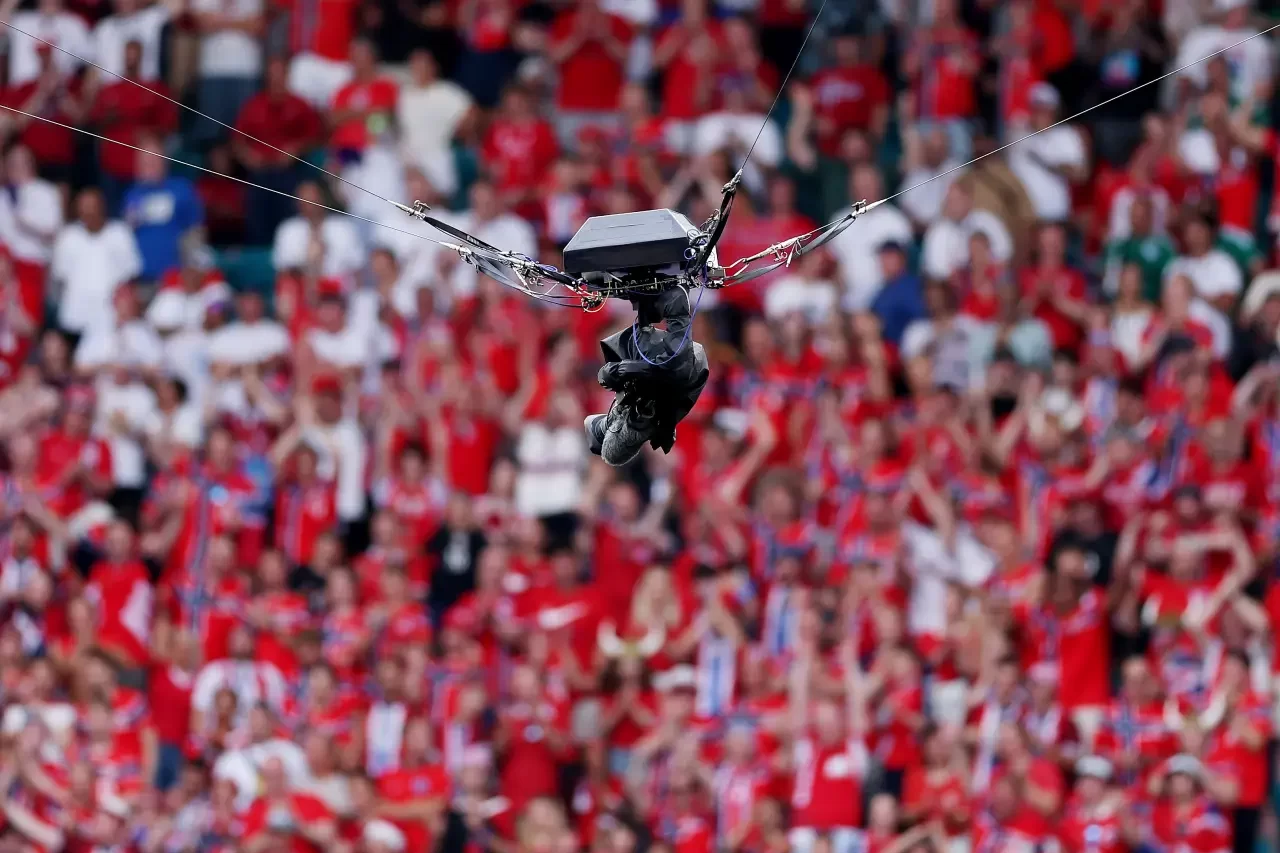
England’s 2026 FIFA World Cup quarterfinal victory over Norway was overshadowed by controversy after Norwegian players claimed the ball struck the Sky Cam cable moments before Jude Bellingham’s equalizer. FIFA, however, rejected the claim, citing data from the sensor embedded inside the official match ball.
Controversy before Bellingham’s equalizer
The incident occurred during first-half stoppage time when Norway goalkeeper Orjan Nyland launched a long clearance. Norwegian players argued that the ball hit the suspended Sky Cam cable above Hard Rock Stadium, causing it to drop shorter than expected and allowing England to regain possession.
Elliot Anderson collected the ball before setting up Anthony Gordon, who assisted Jude Bellingham for England’s equalizing goal.
Nyland, Erling Haaland and several Norwegian players immediately protested, while head coach Ståle Solbakken confronted referee Clément Turpin at halftime.
Assistant coach Kent Bergersen told Norwegian broadcaster TV2:
“Just before the goal, the ball hit the camera cable, changed direction and dropped much shorter than it should have. The referee should have noticed it.”
FIFA: No contact detected
FIFA dismissed the protests, stating that the inertial sensor inside the Adidas match ball detected no contact during the flight.
According to FIFA officials, the sensor recorded no impact signal that would indicate the ball had struck the camera cable. The governing body also noted that footage from the Sky Cam itself showed no visible vibration, further supporting its conclusion that no collision occurred.
Officials added that Hard Rock Stadium’s 16 ball-tracking antennas were fully operational throughout the incident.
Ball technology supports FIFA’s decision
Since the 2022 FIFA World Cup in Qatar, Adidas match balls have featured an inertial measurement sensor capable of transmitting data 500 times per second.
The technology is primarily used to support VAR and the semi-automated offside system by precisely identifying every touch of the ball. FIFA also released a video displaying the sensor data from the incident to reinforce its position.
Solbakken remains unconvinced
Despite FIFA’s explanation, Norway head coach Ståle Solbakken maintained his doubts after the match.
“The referee said he didn’t see it and hadn’t received any information confirming that it happened. If FIFA says there was no contact and the chip detected nothing, then there’s nothing the referee can do,” Solbakken said.
However, he insisted the ball behaved unnaturally.
“The ball dropped straight down from the sky right in front of our bench. My assistant coach saw the contact. If the chip says otherwise, what can I say? But the way the ball fell was very strange.”
IFAB rules
Under IFAB’s Laws of the Game, if an external object interferes with play, the referee must stop the match and restart it with a dropped ball.
In this case, VAR official Jérôme Brisard determined there was no clear and obvious error requiring an on-field review.
England eventually defeated Norway in extra time thanks to Bellingham’s second goal to advance to the World Cup semifinals.
After the match, Erling Haaland also reflected on the incident:
“Small moments decide World Cups. Today, a 50-50 decision went against us, and that made everything much more difficult.”